Welcome back to Kitch’s Corner!
This is the second installment of the series where I cover the Basics of Investing. Stay tuned for the March edition, which will focus in on the various asset classes for investing and strategies for targeting each one.
Basics of Investing
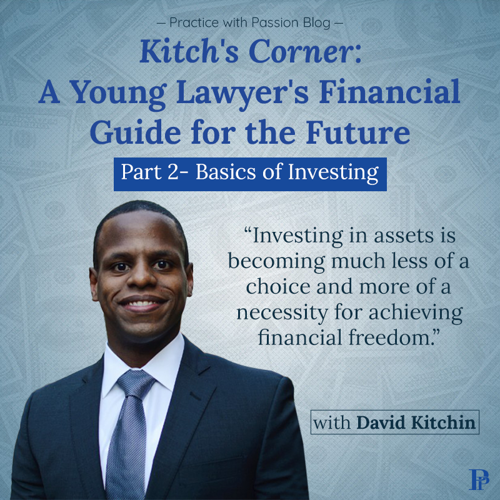
It can be an overwhelming task to decide when, where, and how to invest your earnings, and unfortunately many people will delay making any decision at all. I think it’s fair to say that everyone understands why investing is important – most people, if given the choice, would like to make more money. These days, however, investing in assets is becoming much less of a choice and more of a necessity for achieving financial freedom and growing a nest egg for retirement. Currently, a significant number of attorneys in the US will not be covered by a traditional pension plan, as they have been replaced with self-managed retirement accounts. Therefore it is important to start investing for retirement as soon as possible.
While there is no “secret sauce” to successful investing, there are general rules and principles that you can learn about the financial markets, that can help demystify the world of investing. Today, we will take a look at what investing is, what it is not, and what are the important factors you should consider before you begin to invest. Next month in this column, we will also look at the various asset classes, basic portfolio analysis, and investing for retirement.
Understanding Compound Interest
The utility of making investments lies in a theory that Albert Einstein once called "the greatest mathematical discovery of all time": compound interest. Simply put, compound interest is interest that is earned on previously earned interest.
For example, say that you start with an investment of $200 invested at a rate of 3% per year for two years, and each year you take out the interest. After the first year, you earn $6 and remove it, then the next year you earn $6 again for a total of $12. However, if you use the same figures but do not remove the interest, then after the second year you would earn $6.18 for a total of $12.18 – that’s the power of compound interest and it applies to every type of investment!
Whether you place your money in an interest-bearing account, receive dividends from stocks, or see the value of your investments increase, the goal should be to compound your earning.
When you think about compound interest, its greatest effects are seen over time – this is why it is so critical to invest money as early as possible. Personally, I recommend that everyone have investments of some sort before entering law school, but if not then, you should start with any earnings you have from working over the summer or during the year. In a later article, I will explain why you should think about using your summer earnings to start a qualified retirement account – especially if you plan to work for a large firm.
Determining Your Risk Tolerance
In theory, financial markets have a risk-reward tradeoff, which means investors who take more risks expect to get higher returns, while investors who take less risks will get lower returns. This simple theory shouldn’t be construed as a predictive indicator of future returns, but it is a good starting point for beginning investors to understand the sort of investments that fit them best.
Before making any investments, you should consider the factors outlined below and try to determine the right amount of risk for you.
Age
This is one of the most important factors to consider when determining your appetite for risk. Young investors are usually more inclined to hold investments with higher risk, while older investors (especially those approaching retirement) tend to hold less risky assets.
A simple way to determine your risk tolerance is to take your age and subtract it from one hundred. For example, if you are 25 years old, then your portfolio should consist of 75% stocks and 25% bonds, cash and other safer assets. While this method is not perfect, it is a good way to get a sense of the type of allocation you should be making at your age.
Personality
Ultimately, no two investors are ever the same, so you should consider your personality and preferences when making investments.
For instance, if you are someone that would like to invest only in ESG companies, or companies with female CEO’s, etc., then you should do your research and find those assets. The trade-off, of course, is that depending on your preferences, you may limit your investment pool.
Other important personal factors to consider could be:
- Are you married?
- Do you have children?
- Do you support other family members financially?
- Are you a risk-taker or not?
The answers to these questions will help you determine the type of assets and investing style that suits you best.
Your Goals
Before making any investment, you need to have a clear idea of your short and long-term goals.
For example, if you are planning to purchase a home in the next two years, and a considerable amount of your down payment is invested in the market, then you need to determine how important that home is – because if you are invested (especially in risky assets) you might lose money.
Alternatively, if you would like to purchase a home in the next fifteen years, then you may be able to handle more risk. In sum, as your goals change, your asset allocations and risk tolerance should change as well.
Investment Goals
Another important factor to consider before investing is whether you are looking for income or growth.
- Income investing means purchasing assets that pay a dividend or interest on a scheduled basis.
- Growth investing means purchasing assets with the intention to sell them later at a higher price.
Income investing is typically more popular amongst older investors who will need a reliable income stream in retirement, but it can be utilized by younger investors as well.
When purchasing a stock that issues a dividend, be sure to purchase it before the “ex-dividend date”, or you will not be registered for the dividend distribution.
Investing vs. Trading
At this point, it is important to make a distinction between investing and trading. Although these terms are used interchangeably, it is better to think of them as distinct concepts.
Generally, investing focuses on the gradual accumulation of wealth by buying and holding assets that you believe have long term value. A “real” investor should always perform a thorough analysis before committing any capital to an investment.
Unlike investing, trading is more similar to gambling at a casino. The aim of a trader is to generate high returns by buying and selling assets, often based on price movements and volume rather than underlying value.
Another important difference between trading and investing is the general level of risk associated with each style. Traders tend to take on more risk since they are not focused on the intrinsic value of an asset.
As we have seen with the surge in GameStop and other “meme stocks”, traders are willing to speculate on risky assets that don’t appear to have intrinsic value. Many traders will also take out “margin” (borrowed money from broker-dealers) to hold larger positions.
This behavior can create huge swings in prices, leading to both dazzling wins and catastrophic losses.
If you would like to utilize both investing and trading strategies, I recommend creating separate categories for each in your monthly budget. It is also a good idea to use different brokerage accounts for each category.
Personally, I like to set aside no more than 3% of my income for speculative bets, i.e., trading.
To be clear, there is no such thing as a truly risk-free investment. However, if you actively trade instead of invest, you should pay close attention to the tax implications. Selling securities owned for less than a year may subject you to short-term capital gains tax, which is typically higher than long-term capital gains tax.
Conclusion
Whatever method you decide to employ in order to grow your money, whether it be trading or investing, the key is to start early and keep up to date with business news.
Stay tuned for the next article in March, where I will give you an overview of the various asset types you can invest in and provide important resources that will help you become a more informed investor.